

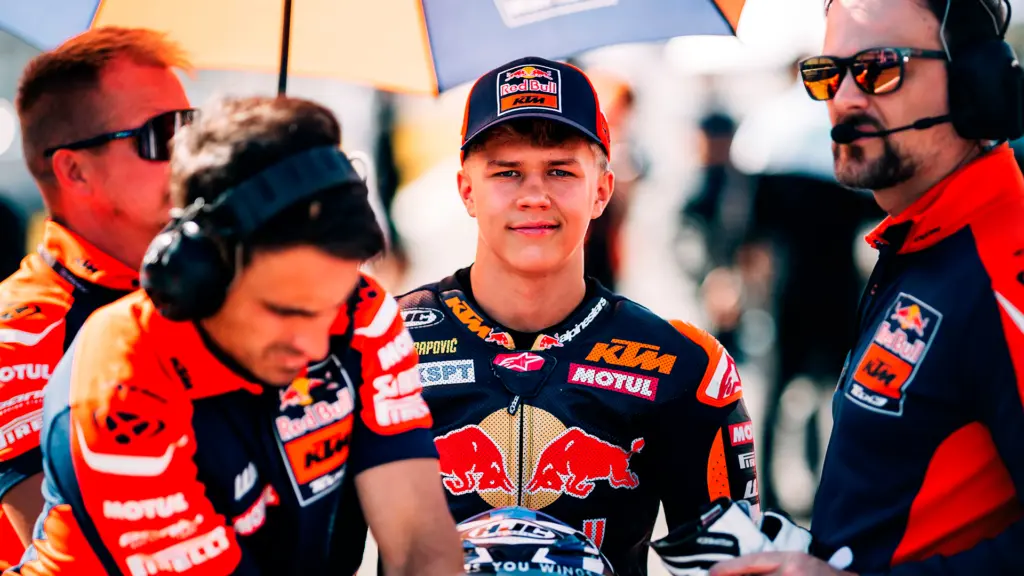
The straight narrows toward the turn, and the speedometer reads 250 kilometers per hour. The riders don’t feel the airflow, as they’re hunched over in the optimal riding position within the tightly packed pack of Moto3 bikes. The 250cc engines breathe freely, but the lives of the men riding them are turbocharged and fleeting. They lean into the turns with nearly two gs of force as the engines roar within touching distance of one another. In the midst of it all, Rico Salmela controls every movement with subtle precision, his mind empty, in ethereal calm.
– When everyone is going 200 km/h, there’s no longer any difference in speed within the group. You’re moving in your own dimension, in silence. That’s when you have to be aware and alert. And, if necessary, bold and aggressive. The only things on your mind are aggression and defending your lines. There are no gaps. Superiority is decided by the little things. Lines, braking, who can take the turn most boldly, Salmela describes.
– The hardest part is focusing solely on your own performance and maximizing your own pace. You can’t think about lap times or rankings. Those will come only once you understand what you need to do to go faster.
Once the race is over, they head to the pits at Jerez, Silverstone, Sepang, or some other track familiar from Formula 1 races. They’ll spray champagne and dodge the flashbulbs, living for a moment the glamorous life of motorsports. But when the plane’s wheels touch down on the runway at Helsinki Airport the next day, and a little later the headlights sweep across the driveway at home in Nokia, it’s time to take a moment to rest where it all began 16 years ago.
On the motocross track at age two
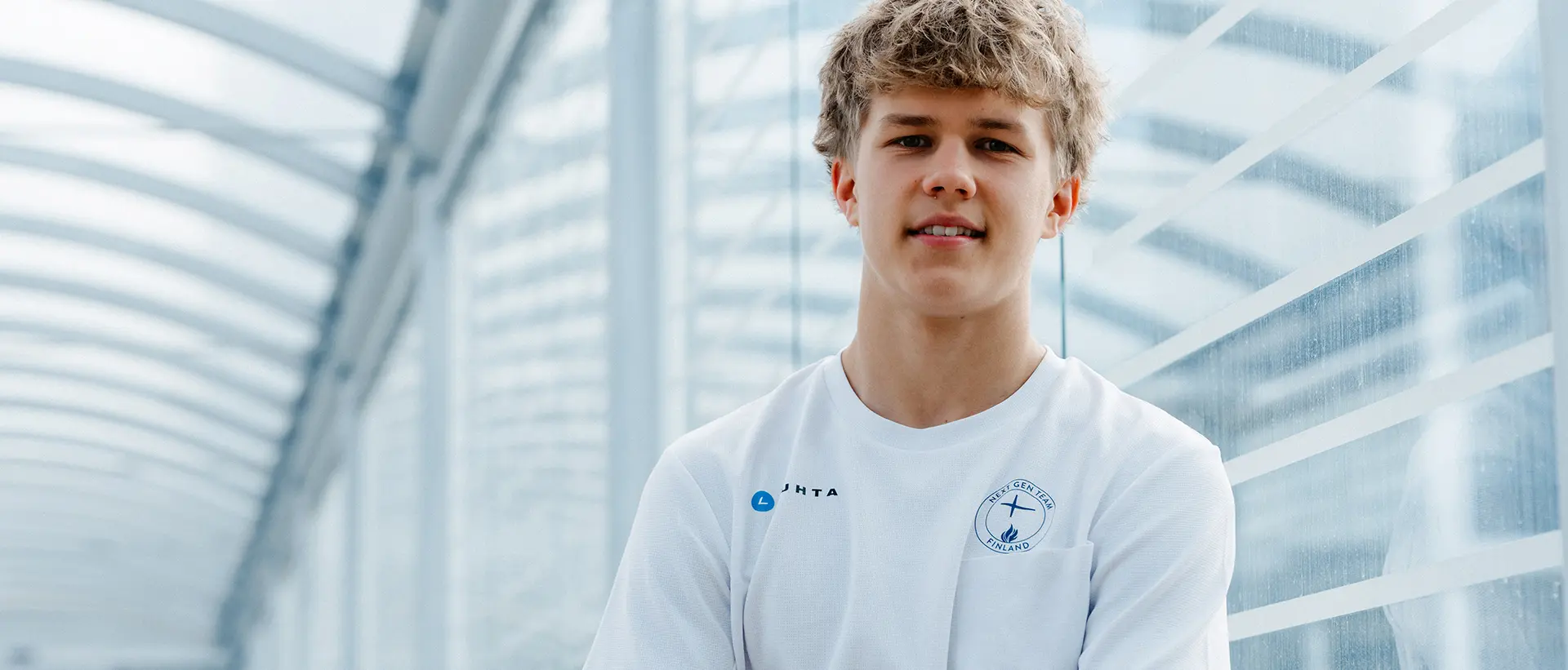
Rico Salmela is a rarity in Finnish sports: the first Finnish rider in the Moto3 class of road racing in a long time. At just 18 years old, he is following in the footsteps of Jarno Saarinen, Teuvo Länsivuori, and Mika Kallio. Now in his first year as a professional, Salmela is well-mannered, calm, and unassuming, but a determined and goal-oriented young man who has been racing on tracks around the world since he was in elementary school.
– My dad used to race motocross and supermoto in domestic series. I used to hang out in the pits and observe things very closely. Of course, I don’t remember any of the events, but there are video clips of me riding a motocross bike when I was under 3 years old and being able to keep it upright without any problems, Salmela says.
Salmela also practiced Brazilian jiu-jitsu as a child, but when he got to ride a minibike on asphalt for the first time at age 5, that was it:
– There was the thrill of speed and the excitement of getting going. It was scary, nerve-wracking, and exhilarating. I tried to stay composed. As the speed picked up, the rush of adrenaline gave me an incredible high, and I knew this was my thing.
With enthusiasm and natural talent, progress came quickly.
– At just 6 years old, I was already racing in the Finnish Junior Championship series with a special exemption as a minor, riding a smaller bike than the others. I still did well, and even back then I somehow realized that this could lead to something. At age 7, I was already competing in the European Championships for riders under 10 in Italy and the Netherlands. Since then, I’ve spent most of my life abroad.
At first glance, the idea of a European Championship series for 10-year-olds on European racetracks seems strange and absurd. But it didn’t faze Salmela.
– In Finland, people may not realize just how incredibly popular and high-profile the sport of road racing is around the world. In Italy and Spain, people are truly fanatical about the sport, and the competition is extremely fierce even among the youngest riders. If you want to be part of that world, you can’t just stay in Finland and wait.
Salmela recalls how he spent his childhood summers traveling around Europe in his family’s motorhome.
– It was really cool. Seeing new countries and places. And I also made like-minded friends at the pit. But the downside was that it was sometimes hard to keep up with school. Toward the end of middle school, it was already pretty hard to balance school and sports, as the trips started lasting months and I was abroad for most of the year.
A dream life on the professional tour
By the time he finished elementary school, Salmela was so determined to become a professional that he decided to devote all his efforts to achieving that goal.
– This has really been a family project. My dad and my manager Aki Ajo have raised hundreds of thousands of euros to make this racing possible. I am incredibly grateful to my parents, Aki, and all my supporters for making this possible.
Salmela also knows how to make the most of the support he has received through the Olympic Committee’s Next Generation program.
– The support from the NG program has made things easier and improved the quality of my training. Outside of the competition season, I still have to pay for all my training out of pocket. I have two bikes and a base in Spain, and maintaining them is expensive. In addition, I need expert assistance in my home country as well, and I’ve been able to find that through the collaboration between the NG program and the Varala Training Center.
In the 2025 season, Salmela finished fifth in the Junior World Championship and fought for a medal position right until the end. After the season, the top seven riders in the junior series were offered contracts in the Moto3 class of the Senior World Championship. In total, approximately 100 of the world’s best road racers compete across three different motorcycle classes.
– Manager Aki Ajo negotiated with my current team, KTM Red Bull Tech3, for nearly a year before the deal was finalized. It was an amazing feeling when I found out I’d be joining the World Championship series. We went to Italy to shake hands and sign the contract. It felt like a small victory. I tried to be professional and keep my feet on the ground, Salmela smiles.
Once his Moto3 contract was finalized, Salmela began an intensive training regimen in preparation for the senior World Championship series.
– Despite our thorough preparation, the start was still challenging. The gap in skill level compared to the Junior World Championship series isn’t huge, but the field is much broader, and there can be 15 riders within half a second of each other.
– The adult series features seasoned drivers who don’t make mistakes. You have to grow into it—there’s no time to adjust to new tracks, everything is precise, and the standards are really high. Every member of the team is a top professional. It’s exciting and inspiring to be part of that world, says Salmela.
Motor sports are often associated with big money and glamour. The world of road racing is no exception.
– About half of the riders on the World Championship tour earn good money and ride under lucrative contracts, mainly in the MotoGP class. The rest are fighting to get there. There’s certainly a certain glamour to it, and it’s fascinating; it’s great to be respected. Life in the paddock, the crowds of fans surrounding you, media attention, PR and sponsor events… you can enjoy all of that, but you shouldn’t let it blind you. When you go out on the track and race, you only get points for speed.
– In any case, I feel like I’m living my dream life right now. This is the life I’ve been striving for since I was a kid, Salmela sums up.
What is Next Generation Team Finland?
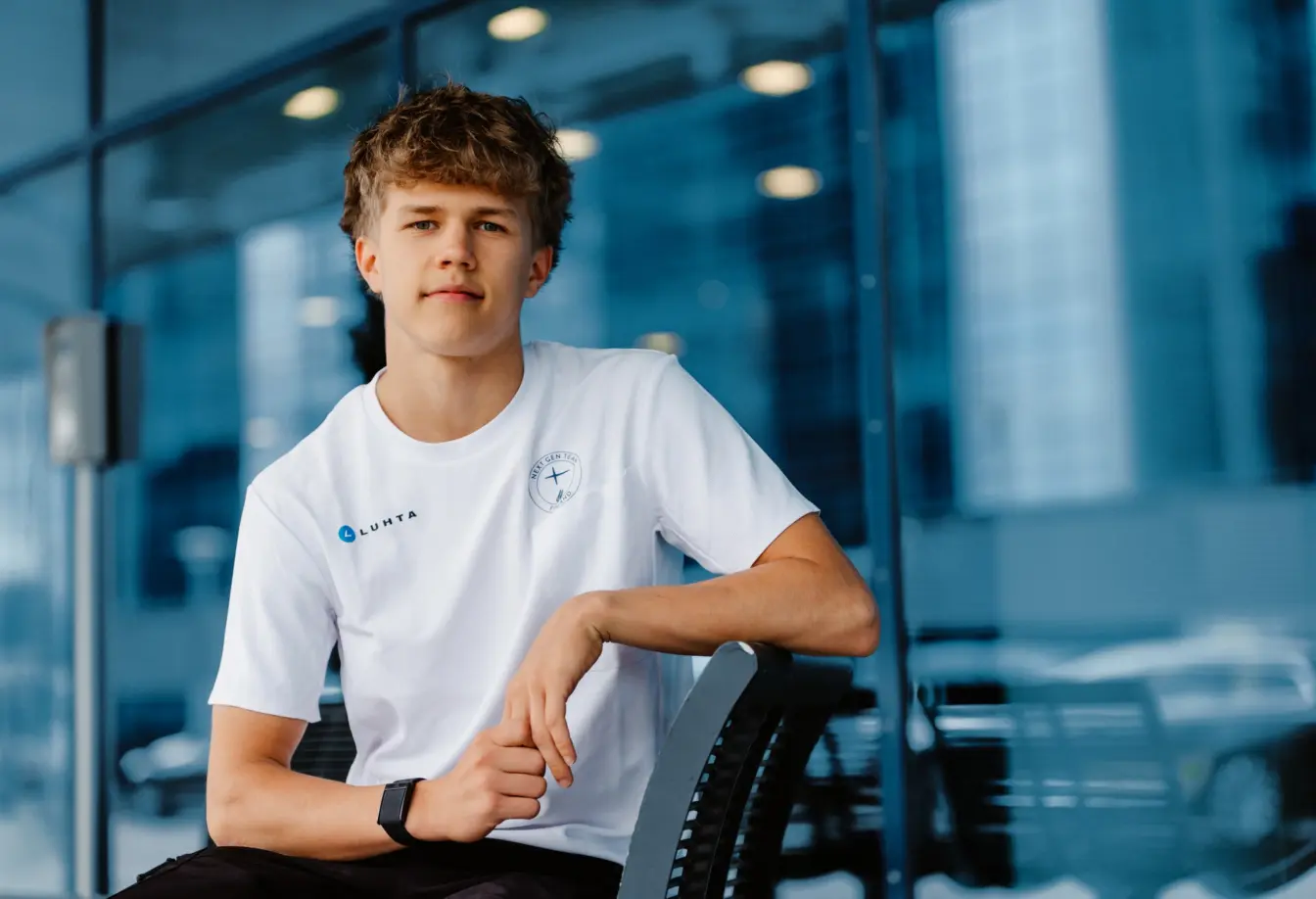
The Finnish Olympic Committee has launched the Next Generation program, aimed at elite young athletes aged 15–22.
The program aims to better identify athletes with the potential for success and help them reach the absolute top of the world. In the first phase, 21 young athletes have been selected for the program, including road motorcycle racer Rico Salmela.
Through the program, each young person receives a personalized support package worth over 10,000 euros, which includes funding, expert guidance, products, and services. The program is implemented in collaboration with sports federations and the elite sports network.
There are no shortcuts to top speed
Although Salmela now has nothing but opportunities ahead of him, the door to the very top of road racing won’t stay open if the quality of his work slips.
– There are no shortcuts, and you can’t skip the hard work. You have to know every track by heart and master every racing line. I watch a lot of onboard videos and think about which gear to use in each section.
– My favorite tracks are the ones with lots of left-hand turns. There are more overtaking spots than, say, in Formula 1. Slipstreaming is very useful, and you have to know how to break away at the right moment to overtake. That takes practice, too.
The World Championship season consists of 22 races, all following the same format.
– I’ll head to the race venue on Tuesday or Wednesday, and then we’ll get to work with the team. First, we’ll walk the track. Then we’ll test the racing lines and the bike. We have to learn quickly because there’s no time to waste. Everything is precise, and I’ll notice right away if I’m 10 centimeters off the line I took before.
– Practice starts on Friday, and the competition is on Sunday. Then we’ll go home for a couple of days or travel straight to the next competition.
The tour travels around the world, and the fall season includes a stretch of over a month in Asia. Salmela is also aware of the discussion surrounding issues of responsibility and environmental impact in motorsports.
– I understand these perspectives, and the issue shouldn’t be downplayed. But the way I see it, people do all sorts of things, and you can find flaws in all of them. This is true in sports, the arts, science, politics, and business alike. Almost everything can be questioned. We need to improve the big picture, and motorsports can play its part in this.
– For me, motorcycling is purely about passion. It’s something I’ve always wanted to do. I love speed. The secret to speed is having confidence and having everything set up to maximize it—just twisting the throttle all the way isn’t enough.
Although the speed-loving boy from Nokia has grown into a cosmopolitan figure on the global motorsports circuit, there is still a hint of Finnishness left in him:
– The national anthem of each country is played for the winner of each heat. The Spanish national anthem has been played way too many times; I already know it by heart. I definitely need to get to hear our national anthem; that’s my number one goal for the near future.
Text translated with the help of AI.