

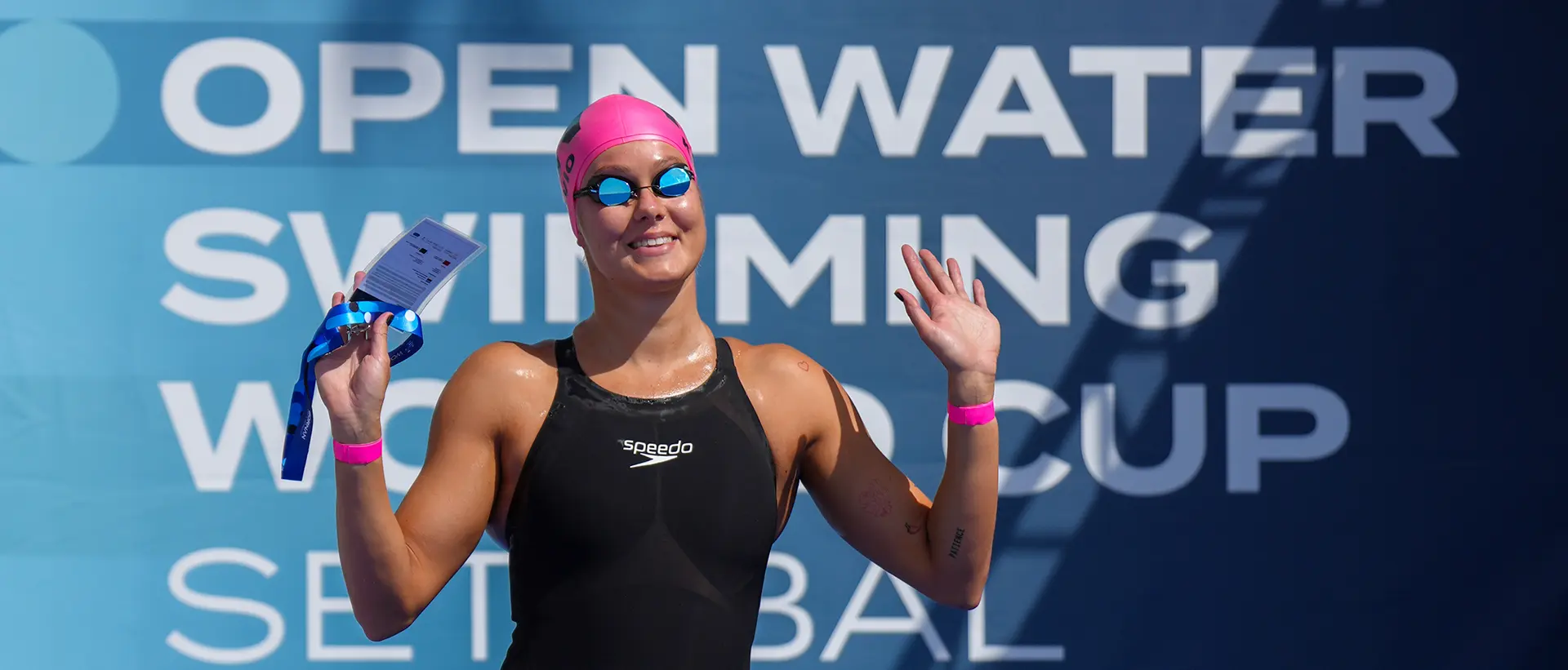
There she comes. With relaxed yet powerful strokes, she cuts through the surface of the Leppävaara outdoor pool, which is numbed by the low pressure. Louna Kasvio, the lone star of Finnish open-water swimming.
When her hand hits the tile, the swimmer looks up from the pool, and a faint smile flits across her face.
– Sorry, but could you move over a little so I can see that clock on the wall? I thought I’d swim for a little while longer, Kasvio chuckles.
She’s already been swimming for a while. Almost two hours. Her usual amount every morning.
A little while later, the workout is over, and a strong swimmer climbs out of the pool.
– I’m really going all out here. This is my life now – full-time, professional swimming, Kasvio says.
Going all out means some staggering numbers: 80–100 kilometers of swimming per week. Three strength training sessions and four dry-land aerobic workouts. 30–35 hours of training per week. Every minute of the remaining time is devoted to recovery or preparing for the next workout.
– The best thing about sports is absolutely everything: training, competitions, and the whole life of an athlete. Sports are a natural choice for me; I’ve never questioned it. It comes from within, from my own desire, Kasvio says
There is a sense of gravity in the swimmer’s voice that conveys a message. Kasvio is a member of the most famous swimming family in Finnish sports history, but she wants to be known for her own achievements.
– When I was younger, it annoyed me when people were always comparing me to my dad. Or my grandparents. Or my grandparents’ parents. I decided early on that I wanted to forge my own career and achieve my own successes.
A top swimmer of the fourth generation
Let’s set the record straight: Louna Kasvio’s father and coach, Antti Kasvio, is a world champion, European champion, and Olympic bronze medalist in freestyle swimming; her grandfather, Matti Kasvio, represented Finland in freestyle swimming at the 1964 Olympics, and her grandmother, Ulla Patrikka, competed in backstroke at the 1968 Olympics. Ulla’s parents, Einari and Rauha Patrikka (née Mäkinen), also competed at the top level in Finnish swimming. The patriarch of this swimming dynasty, Taisto Kasvio, served as a coach for the national team in his day, and his wife, Mila Kasvio (née Leskinen), represented Finland at the Antwerp Workers’ Olympics in 1937. Her family history is full of star power, but Louna Kasvio herself has already achieved something that no one else before her has been able to do: she is the first Finnish open-water swimmer to achieve international success.
Four generations of high-performance athletes in the same sport is a story that is quite unique even on a global scale. Louna Kasvio doesn’t shy away from talking about her family background, but she doesn’t make a big deal of it either.
– In our family and among our relatives, we’ve always talked a lot about swimming. Swimming has been central to our lives, and it’s been a natural part of who we are. But no one forced me into the pool. I don’t dwell on the past or feel pressure from my family background; instead, I look ahead to my own career.
The family’s swimming expertise is most evident in Kasvio’s career in terms of coaching. Coach Antti Kasvio says that his own experiences as a high-performance athlete are undoubtedly beneficial in his coaching work, but on the other hand, the era is completely different now.
– In my opinion, open-water swimming is just swimming like any other sport, even though it’s obviously a marathon-length event. In other words, it’s long-distance swimming in varying conditions, where your competitors are right on your heels the whole time.
– Back in the day, I trained for a 2–4-minute performance, whereas Louna’s performance lasts 120 minutes, so you can’t just use the same training routine. Even though I, too, did a lot of high-volume training back in the day and gave it my all for several years, I’d say that Louna’s process is even more brutal.
In his coaching philosophy, Antti Kasvio places particular emphasis on technical skill.
– We focus on ensuring that, through good technique, you can swim at the anaerobic threshold for the entire race and vary your pace within it. Louna’s intense workouts are usually race-like, where you swim really hard for a long time and then do shorter bursts at an even higher intensity at the end, Antti Kasvio explains.
From the track to open water
Kasvio’s path to the top of the open-water swimming world has been straightforward, but not a foregone conclusion. She learned to swim when she was not yet 3 years old, but it took years after that before her competitive spirit really kicked in.
– I wasn’t very sporty as a kid; I liked to read, talk, and do all sorts of other things. In first grade, though, I won the 25-meter race at an interscholastic swimming meet. That was a huge sense of accomplishment, and I started training more.
At the age of 10, I was already facing my first age-group championships.
– I did well there, and after that, swimming became more than just a hobby. I was already training about five times a week back then, Kasvio recalls.
Her progress continued steadily, and by the age of 17, she was already a medalist at the European Junior Championships in pool swimming and a finalist at the European Championships for adults.
– The following year, however, was tough. I was sick a lot and faced many challenges. That’s when my aunt encouraged me to try open-water swimming at the Finnish Championships in Raasepori. It was cold and raining, but I finished second out of all the competitors in both the men’s and women’s divisions. I was left with a great feeling, so I went on to compete in the European Junior Championships, where I immediately placed fifth. That instantly added a whole new dimension to my swimming and my life. Competing in open water was more interesting, and I was hooked, Kasvio explains.
Open-water swimming has little tradition in Finland, and the sport has only become mainstream in the 2010s.
– Compared to pool swimming, the biggest difference is definitely in competitions. It took me a little while to get the hang of what it’s all about. Technically, the difference is that when swimming, you have to look ahead, and under certain conditions, your stroke rate needs to be higher because the swell makes it harder to move forward.
In addition to the technical aspects, there are also physical and tactical challenges.
– In an open-water race, you can’t set your own pace; you have to stay with the main pack right from the start. The draft is huge, and if you fall behind the group, you won’t be able to catch up. However, drafting isn’t easy, because the seas can be rough and visibility isn’t always good.
– Up to 80 swimmers can be swimming side by side within touching distance of one another. You have to hold your own, but it’s still more important to stay calm than to be aggressive. Aggression raises your heart rate and throws off your technique.
In addition, the energy refueling that is part of the competition is a unique feature in its own right.
– The coaches hand out drinks from the dock using fishing rods; it gets pretty crowded, so you have to pay close attention to find your own water bottle. You only have two or three seconds to drink, and even then, you have to keep moving forward the whole time.
Natural conditions can also vary greatly. Water temperature can vary by as much as 10 degrees, and you may encounter jellyfish, fish, sunken logs, or debris in the ocean.
– There’s been, and still is, a lot to learn in these areas, but that’s exactly what makes the sport so interesting. For me, the best conditions are cool weather that isn’t completely calm. I feel like I’m tough and can handle challenges. I get hit by my competitors, and by the time I cross the finish line, I’m usually pretty beat up—that’s just part of the deal.
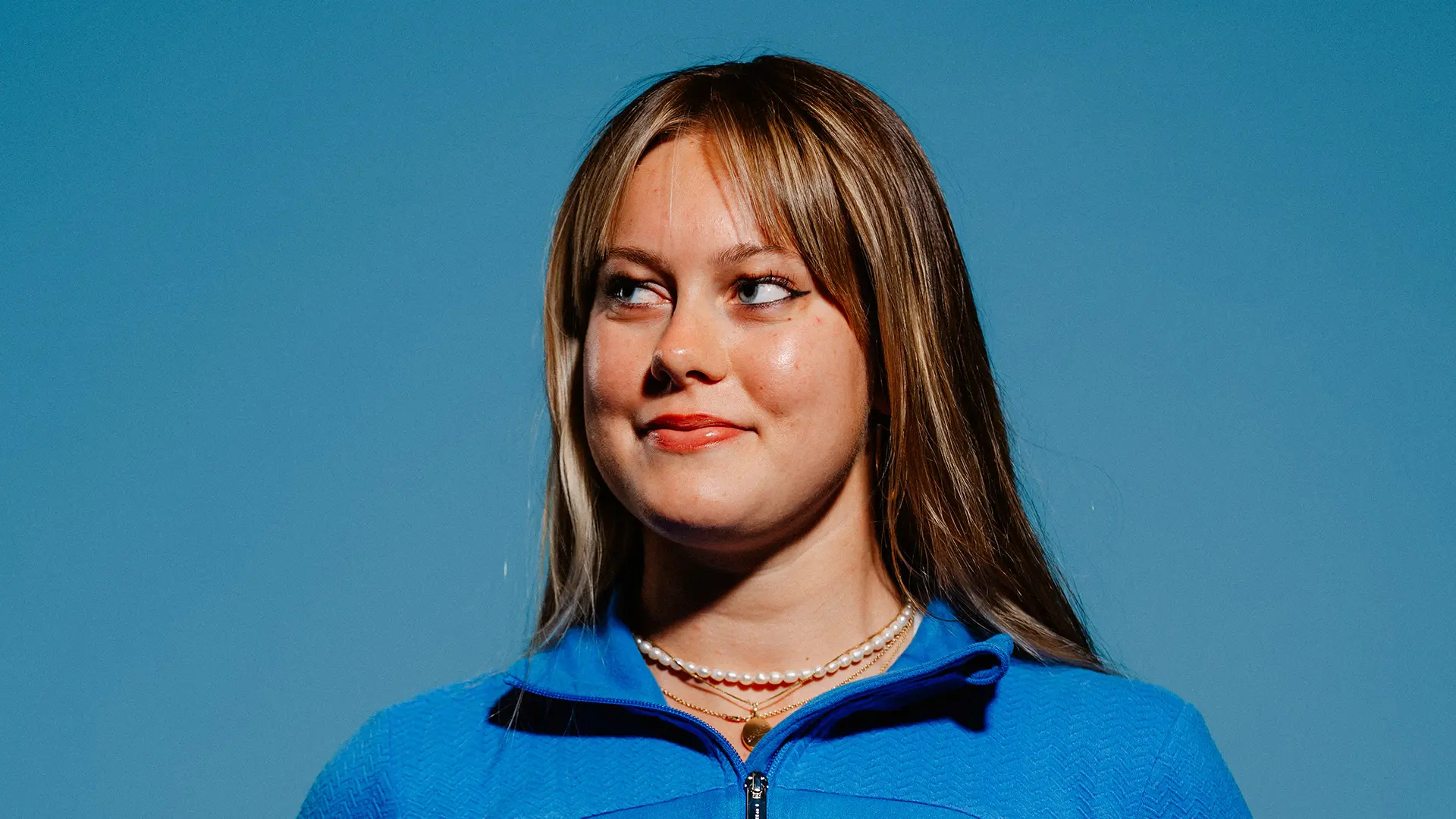
I believe that my fitness level and swimming skills are already close to the world’s best. I’ve trained with medalists at major competitions, and I know I can keep up with them.
On my own path to the top
In Finnish swimming circles, the Kasvio family is known for blazing their own trail and running a family business where the daughter swims, the father coaches, and the mother, Hanna, handles logistics and management.
– We all have high standards, and we’re ready to invest heavily in Louna’s career. She spends more than a third of the year abroad, which involves a great deal of logistics and coordination,”says Hanna Kasvio.
In Finland, a common challenge for elite swimmers is the availability of lanes for training.
– To train for a marathon swim, we’d need to have the pool reserved twice a day for two hours at a time, exclusively for our own use. That’s not always possible at municipal swimming pools. Foreign competitors don’t face these challenges; they train continuously in private pools or on lanes reserved exclusively for them, Hanna Kasvio notes.
Although Louna Kasvio has had to concede a slight advantage to her international competitors during training, she has managed to keep up with the top international pace. In the 2025 season, she won the overall title in the Junior World Cup and finished 19th at the Senior World Championships. This summer, she placed 8th in the 10-kilometer race and 10th in the 5-kilometer race at the Women’s European Championships.
– I believe my fitness level and swimming skills are already close to the world’s best. I’ve trained with medalists at major competitions, and I know I can keep up with them, Kasvio said.
– Climbing to higher rankings requires constantly refining your technique in different conditions, as well as the ability to use tactics and follow the pack. In open water, there are many different ways to do well, and the routine you develop through experience plays a key role.
Perhaps this is also why swimmers reach the top of the world in open-water swimming at an older age than in pool swimming. On average, swimmers don’t win World Championship or Olympic medals in open-water swimming until they are 24–25 years old. Kasvio, who is 20, still has plenty of time, but not so much that he can afford to waste it.
– You have to keep improving. Hard practices make me feel good. My dad’s coaching style is demanding, and there’s no time for idle chatter during practice. At the same time, I know that if I get praise, it’s well-deserved.
At its worst, swimming can be monotonous. The Kasviot have addressed this by varying the rhythm and content of their workouts.
– I swim a lot of different sets in different places and under different conditions to keep things interesting. Still, not every training day is a walk in the park. The toughest ones are those early mornings in the dark Finnish autumn, when we head to the pool at six o’clock. But it’s easy to get through those mornings because I know that hard work pays off.
Throughout her career, Kasvio has become known as a fairly consistent swimmer who always delivers in major competitions.
– My philosophy is that as long as I’m not sick or injured, I always perform well. I’m well-prepared and always feel comfortable in the water. When that happens, success is a natural result.
Kasvio looks to the future with confidence and calm. Her goals are ambitious, but they involve much more than just results.
– I hope to have as long a career as possible and to enjoy swimming from start to finish. Of course, I also want to succeed, but above all, I want to reach my full potential. Right now, I don’t want any other kind of life or a break from swimming. There will be time for that later, when I’m older.
Text translated with the help of AI.

What is Next Generation Team Finland?
The Finnish Olympic Committee has launched the Next Generation program, aimed at high-performance athletes aged 15–22.
The program’s goal is to better identify athletes with the potential for success and help them reach the very top of the world. In the first phase, 21 young athletes have been selected for the program, including swimmer Louna Kasvio.
Through the program, each young athlete will receive a personalized support package worth over 10,000 euros, which includes funding, expert guidance, products, and services. The program is implemented in collaboration with sports federations and the elite sports network.