

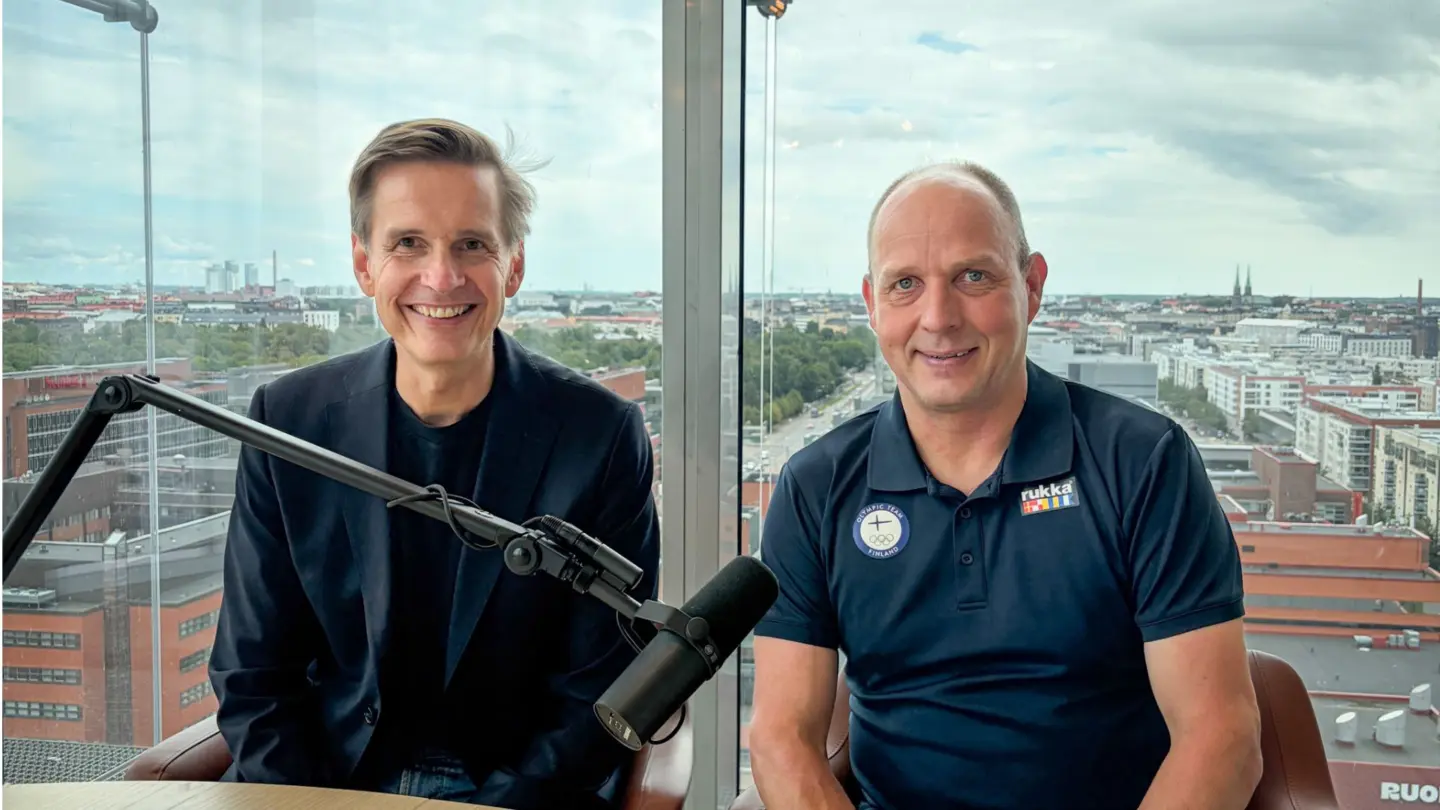
 Sami Laine and Janne Hänninen.
In sport, there’s often talk of development and improving performance — can anything from high-performance sport be applied to the business world? In the latest episode of the “Better is Possible” podcast, Sami Laine’s guest is Janne Hänninen, the Finnish Olympic Committee’s Director of High-Performance Sport, who has had a long career as an athlete. In the episode, Janne Hänninen also talks about how he managed to stay motivated throughout his sporting career and whether it is possible to motivate someone else.
A dream and a goal are not the same thing
In the spring of 2026, Deloitte and Demos Helsinki published a report based on interviews with 20 foreign CEOs and executives who lead Finnish companies. The study aimed to determine how they view Finnish leadership, goal-setting, and barriers to growth.
The interviews highlighted four recurring obstacles to growth: goals that are too low, risk aversion, prioritising consensus and comfort over challenge, and emphasising efficiency at the expense of renewal. The study also identified three ways to overcome these barriers to growth.
According to Janne Hänninen, in sport people often talk about development or improving performance rather than growth. Dreams come first, goals follow — when you’re ready to work towards them. An athlete’s goals evolve throughout their career and are not set in stone. A dream and a goal are two separate things: for very few athletes in their twenties, an Olympic gold medal is a realistic goal.
What you do is more important than the goal
The courage to set goals comes from what we’re willing to do to achieve them. A goal should be realistic, but what matters more is what we do every day and how we improve it. By changing the way we do things, we can achieve new results.
According to Hänninen, there is an ongoing discussion about the direction high-performance sport should take and how things should be done. Guidelines are developed in collaboration with his team and network. The best idea always wins, no matter who comes up with it.
– I’m uncomfortable with the idea that, as a top sport executive, I should be the one to set all the guidelines. They are developed collaboratively. You can’t simply dictate from the top that this is how things will be done, Hänninen reflects.
In high-performance sport, results are visible. It is important to focus on the factors that influence those results, measure them, and track progress. This requires honest dialogue.
– It’s about how I can do the right things as well as possible every day to achieve the goal, Hänninen reminds us.
What can the business world learn from athletes?
The best athletes are willing to do whatever it takes to improve. When a coach is brought on board and both parties share a common goal, even uncomfortable topics can be brought up without damaging the relationship.
The same applies to the business world: you can’t succeed without directnessand honesty. It’s important to work towards a common goal, not your own interests.
Progress requires cooperation
In Finnish sport, there is a tendency to be somewhat siloed, and the interests of individual sports take precedence. In Norway, expertise is concentrated at a high-performance sport centre, and they follow the 70–20–10 model: 10% formal education, 20% mentoring, and 70% on-the-job training.
Norwegians share a great deal of knowledge, and expertise develops through natural interactions in everyday life.
– Developing skills, challenging, working together, and supporting one another. We do that a lot, Hänninen explains.
Innovations arise when we work together on day-to-day tasks, not alone or in seminars.
– We’re somewhat siloed, whereas in Norway top experts are brought together, Hänninen notes.
On risk-taking and honesty
In high-performance sport, taking risks is a constant. It’s not the one who trains the most who wins, but the one who trains the smartest. The most successful athletes take risks, fail, and learn from their mistakes.
– Taking risks is part of everyday life, Hänninen says.
In Finnish companies, people tend to avoid not only risks but also disagreements. In sport, however, disagreements are inevitable. An atmosphere where everyone feels able to express their opinions and discuss issues even when they disagree. Issues must be discussed directly and honestly, as long as people respect one another and strive to find the best way forward.