

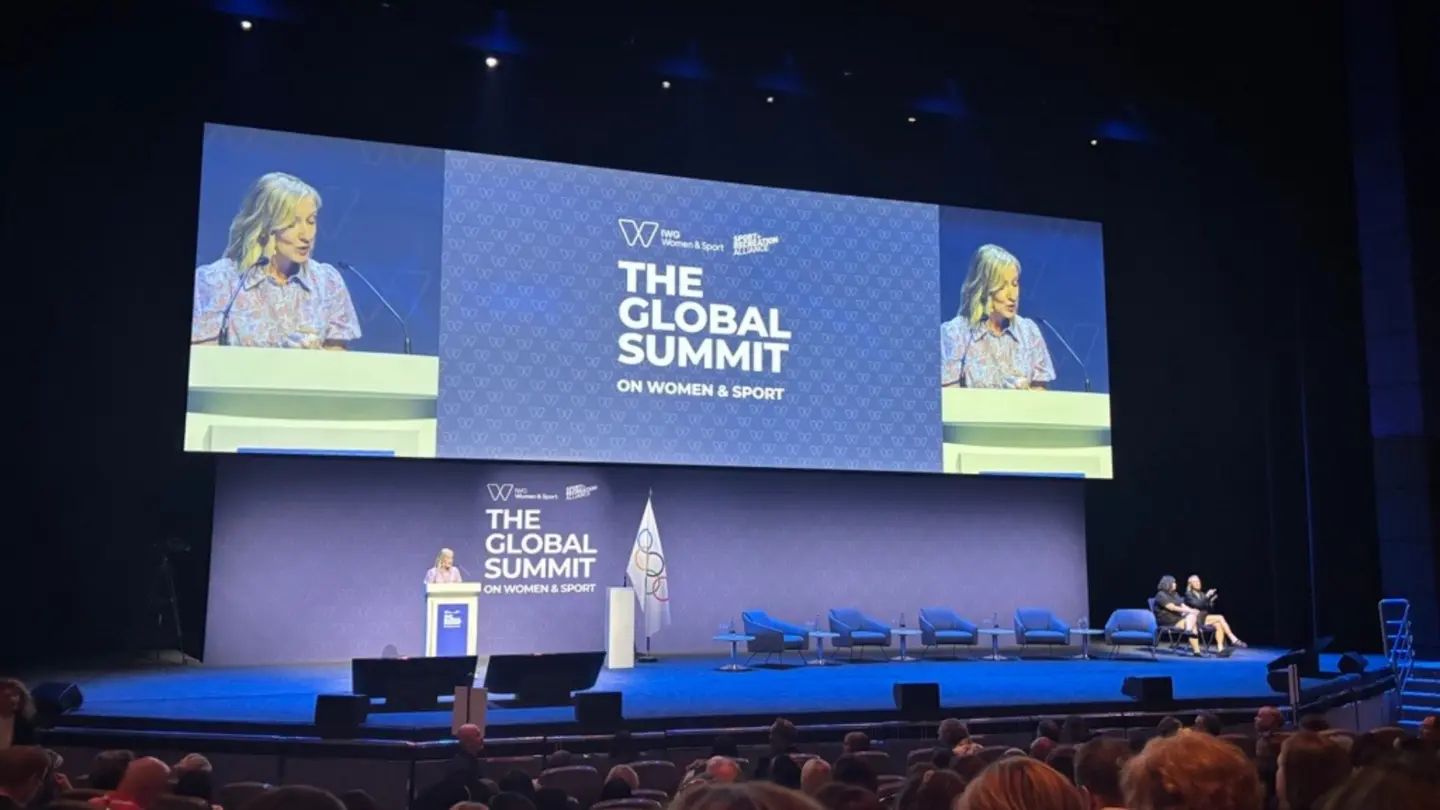
The biggest challenge when it comes to gender equality in physical activity and sports policy is no longer about breaking through glass ceilings or identifying gender equality issues, but rather about making decisions that change the structures. The International Gender Equality Network’s world conference outlined the next steps in gender equality work following the breakthroughs that have been achieved.
The International Working Group on Women and Sport (IWG)’s World Conference on Women and Sport, held in Birmingham in July 2026, brought together 900 participants from 80 countries to discuss how sports governance, funding, decision-making, and organizational culture need to be reformed. Among the Finnish delegation, the view was reinforced that change is based on shared responsibility, cooperation, and putting what has been learned into practice.
Women’s sports are growing and deserve special attention
The growth of women’s sports in recent years has been undeniable. Statistics from the market research firm Ipsos, presented by Trinh Tun, showed that stadiums are filling up, commercial partners are showing interest, and audiences are discovering women’s competitions in a whole new way. Yet one mistake continues to be repeated: women’s sports are still far too often judged by the same standards as men’s sports.
According to investor Michele Kang, this is a strategic mistake.
Women’s sports should not be viewed as an extension of men’s sports or a smaller version of it, but rather as a distinct market with a different audience, different growth opportunities, and different business foundations. Success is not achieved by copying what already exists, but by creating new business models.
A true competitive advantage and increase in value emerge over the very long term. If the goal is to develop elite women’s sports or increase the commercial value of women’s sports, one must consider the entire ecosystem: development pathways for juniors, training programs, research, infrastructure, media, and commercial partnerships. A single success story is not enough if the underlying structure is weak.
The future of women’s sports will not happen on its own; it is built through conscious choices. This also requires a new way of thinking, starting with the structures themselves. It is not enough to simply improve existing structures. We must boldly envision what a sustainable and equitable ecosystem for sports might look like. What Professor Fiona Chambers describes as “design fiction”—that is, the deliberate shaping of futures—is a way to place people at the center of development. The central question is not just what kind of sports we are building, but for whom and why.
The goal cannot simply be to help women and girls adapt to existing structures. The structures must be changed so that they do not exclude certain people from the outset. Then it is not just a matter of how many women participate, but of which ones are able to exercise power, set the goals for the activities, and participate in shaping the solutions.
The next phase for women’s sports requires leadership—not just advocates anymore
Real change rarely comes about through a single major upheaval. It builds up over a long period of time, sometimes almost unnoticed. The importance of perseverance and time was clearly emphasized in, among other things, the speech by UEFA Vice President Laura McAllister. We need what are known as “constructive challengers”—people and organizations that dare to question old ways of working without creating conflict. They change the culture step by step. You cannot set unrealistic timelines for change.
We must turn our attention to the next generation and to the girls who are right now discovering the joy of being active. What opportunities are available to them? And how well do we understand their bodies, their growth, and the specific conditions for their training? Research on women’s physiology remains inadequate in many areas, even though it forms the basis for safe, healthy, and effective exercise programs. And girls and women who need special support, in particular, are all too often subjected to intersecting discrimination and face many different barriers. Finding opportunities requires the right mindset, shared learning, and collaboration. The lack of research is not just a matter of gender equality. It is also a matter of performance, health, and competitiveness.
Athletes’ pregnancies, childbirth, motherhood, and return to elite sports clearly demonstrate how sports systems are often structured around the expected life course of male athletes. Women have been excluded from research because it has been assumed that the hormonal functions of the female body complicate the research. Therefore, more research projects are needed that take female athletes and their life trajectories into account, and this knowledge must be translated into concrete support systems, training practices, and competition rules.
A new approach to leadership in sports involves sharing power and opportunities
At the organizational level, efforts toward gender equality all too often stop at setting goals and delivering speeches. Goals are important, but they do not bring about change on their own. All too often, they remain mere words. Gender equality is not the responsibility of a single gender equality officer, a female manager, a project, or an organization. The responsibility lies with boards, management, coaches, funders, the media, event organizers, government agencies, partners, and all members of the sports community.
According to Sebastian Coen, president of the International Association of Athletics Federations, gender equality within the organization did not progress solely through the setting of goals, but only after binding quotas were introduced, the rules were reformed, and it was ensured that gender equality extended to all levels of the organization, from the board to training programs. The change was also systematically measured. The goal was not merely for women to be represented in the boardroom, but for diverse experiences and perspectives to lead to better decisions and greater participation.
In the field of leadership, there is often talk of “windows of opportunity.” Right now, one such window is open. An exceptionally interesting environment has emerged around women’s sports, where the public, the media, sponsors, and investors are all pulling in the same direction. Now is a particularly crucial time to promote women’s sports, especially as conservative values have become more entrenched. The breakthrough for women’s sports has already happened, and the number of women in decision-making positions has increased within national organizations for fitness and sports. Now it remains to be seen whether we can lead the next step in this development.
Toward Greater Gender Equality in Sports at the National Level
The next step for women’s sports is not about celebrating the breakthrough, but about what we build from there. In line with the conference’s overarching theme, “Beyond the Breakthrough,” the breakthrough is not an end goal, but the starting point for long-term development.
In Finland, this means that exercise and sports organizations must critically examine their own structures. They must evaluate who makes the decisions, where resources are allocated, who is selected as leaders and coaches, what types of facilities are built, how safety is managed, and whose experiences are excluded from data collection.
The conference also served as an opportunity to celebrate the Brighton Plus Helsinki Declaration, which aims to promote equality and gender equality in sports. The 34 organizations in Finland that have signed the declaration already form a broad group that works together to put the goals of gender equality in sports into practice.
Text: Sari Rautio, Marika Uusi-Illikainen, and Karoliina Ketola
This text was translated using AI.
The results from the IWG conference will be discussed at the virtual coffee breaks for gender equality work on September 11, as well as later this fall at the closing ceremony for the “Gemensam resa” project (date to be announced). Gender Equality Coffee Breaks are held on the second Friday of every month. The program consists of a brief introduction to the topic followed by a discussion. Join the Gender Equality Coffee Breaks on Teams.