

Agreement on children’s sport
A joint commitment by sports federations to develop children’s sport. The agreement was announced on 28 November 2026.
The Agreement on children’s sport brings together sports federations to reform sport for children aged 12 and younger. The shared goal is to increase the amount of varied physical activity and extend sport participation pathways.
Nearly 90 per cent of Finns participate in sports club activities at some point during their childhood. It is nevertheless alarming that even among children who participate in club activities, too many are not getting enough physical activity. Children are starting club activities at an increasingly young age, and they are also focusing on a single sport earlier than before. A sport participation pathway that narrows too early may leave too little room for trying out different sports and developing a wide range of movemen skills. Children need opportunities to try things out, find inspiration, and discover their own dreams.
The joint agreement calls for a reform of operating practices
Sports federations commit to reviewing and developing their rules, competition systems, coaches’ expertise, and cooperation with clubs from the perspective of children.
Through sports federations’ pledges, we
- promote competition activities designed around children’s needs,
- increase the amount and variety of physical activity and participation in multiple sports,
- strengthen the expertise of children’s coaches and
- promote financially sustainable children’s sport.
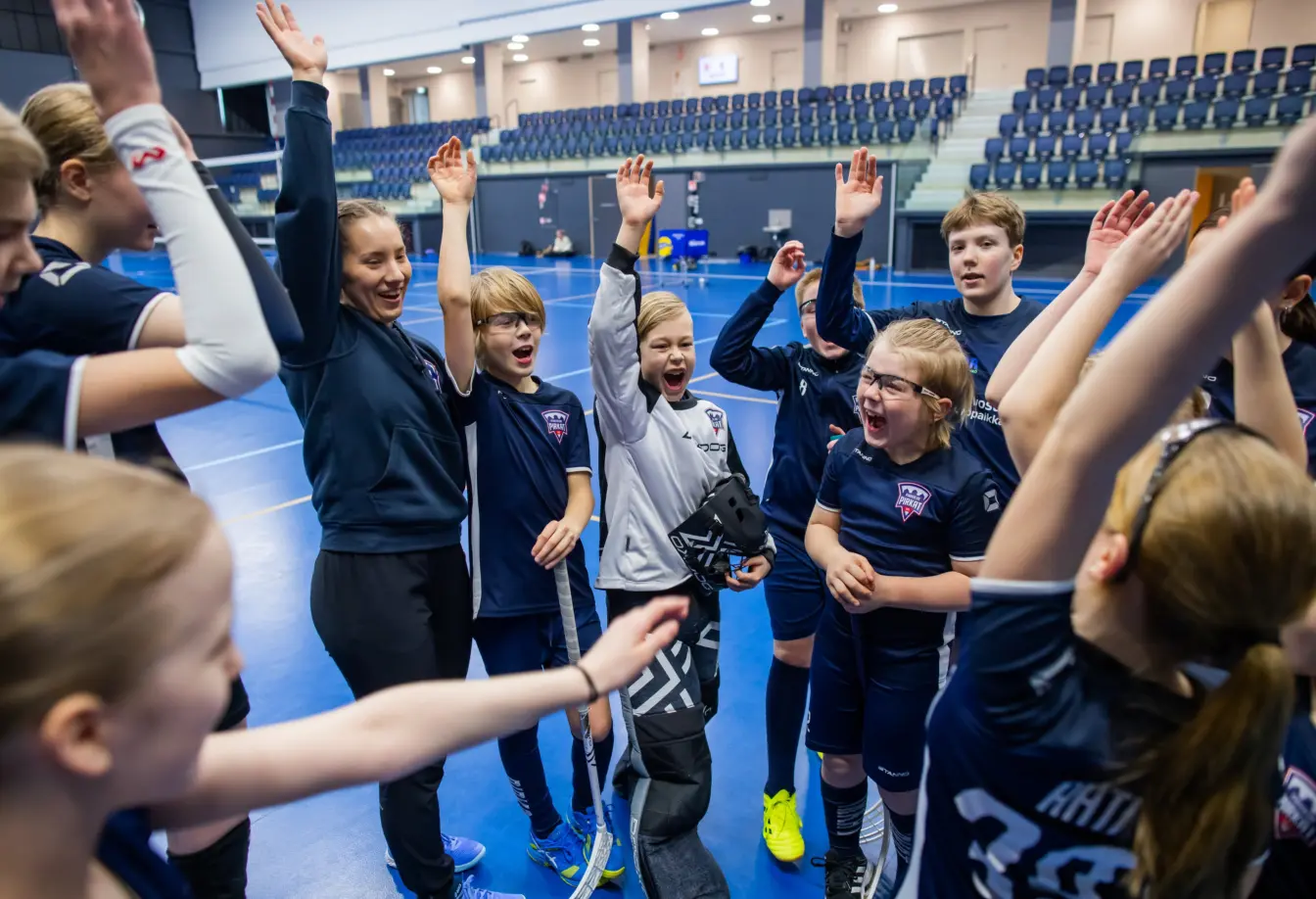
Sports federations’ pledges for children’s sport
For our part, we pledge to commit to the long-term and systematic efforts necessary for the development of children’s sport.
- Children have the right to the joy of sports.
- Adults with expertise are responsible for coaching and instructing children.
- Children’s voices are heard and their views matter.
- Children’s growth, development and well-being are at the core of everything we do.
What does the agreement on children’s sport mean?
Ski Sport, Finnish Divers’ Federation, Finnish Agility Association, American Football Association of Finland, Finnish Biathlon Association, Finnish Shooting Sport Federation, Finnish Cheerleading Federation, Finnish Curling Association, Finnish Disc Golf Association, Finnish Golf Union, Finnish Ski Association, Finnish ITF Taekwon-Do, Finnish Judo Association, Finnish Ice Hockey Association, Finnish Karate Federation, Finnish Bowling Federation, Finnish Basketball Federation, Finnish Cricket Association, Finnish Handball Federation, Finnish Volleyball Association, Finnish Skating Association, Finnish Snowboard Association, Finnish Canoeing and Rowing Federation, Finnish Fencing and Pentathlon Federation, Finnish Boxing Federation, Finnish Padel Federation, Finnish Wrestling Federation, Finnish Weightlifting Federation (SPNL), Football Association of Finland, Finnish Paralympic Committee, Finnish Pesäpallo Federation, Finnish Sailing and Boating Federation, Finnish Cycling Federation, Finnish Table Tennis Association, Finnish Equestrian Federation, Ringette Finland, Finnish Floorball Federation, Finnish Squash Association, Finnish Orienteering Federation, Finnish Taekwondo Federation, Finnish Figure Skating Association, Finnish Dance Sport Federation, Finnish Tennis Association, Aquatics Finland, Finnish Athletics Federation, Finnish Gymnastics Federation, Finnish Strength Sports Federation, Finnish Powerlifting Federation and Finnish Kendo Association.
A tremendous amount of good work is being done in children’s sport, but there are also worrying trends. Fewer and fewer children get enough physical activity. The number of children holding sports licences peaks as early as the age of 11 and then begins to decline, which is far too early. In addition, children often specialise in a single sport at too young an age.
We needed a shared direction across sports that brings the focus back to what matters most in children’s sport: more joy, physical activity and learning, varied experiences and longer sport participation pathways. Competition and development are part of children’s sport. Competition activities should be designed around children’s needs rather than replicate the world of adult competitive sport. They should support learning, enthusiasm and the desire to continue participating in sport.
The first change is that sports federations now have a shared direction and shared pledges. The agreement challenges sports federations to review their activities from the perspective of children and develop their competition systems, operating models and coaching accordingly. Change will not happen overnight; the agreement is a starting point for long-term efforts.
A shared direction does not mean that all sports must do things in the same way. Different sports can adopt different solutions, as long as they lead towards the same goal: more joy, physical activity and learning, and longer sport participation pathways.
The concrete changes will vary from sport to sport. They may include developing competition rules and systems, increasing the amount of physical activity during training sessions, making it easier to participate in multiple sports, strengthening the expertise of children’s coaches and monitoring the costs of sport participation. In addition, children’s voices must be heard more clearly in decisions that affect them.
The agreement does not prescribe a single national operating model for all sports. It provides a shared direction based on which sports federations develop their own solutions and strengthen cooperation with clubs to ensure that the changes are reflected in the day-to-day activities of children’s sport.
An important first step is that all sports federations now encourage children to participate in multiple sports. Children can participate in different sports through organised club activities or independently in their free time. What matters is that children do not have to choose a single sport unnecessarily early. Coaches should see other sports as supporting children’s development rather than as competitors. It is also important to communicate the benefits of varied physical activity to parents.
However, participation in multiple sports is not a requirement. A child may also wish to focus on a single sport. What matters is that the choice is the child’s own and not a consequence of systems created by adults.
We also recognise that factors such as costs, year-round activities and increasing training volumes can make it more difficult to participate in multiple sports.
Sports clubs are independent organisations, and it is in their day-to-day activities that change ultimately takes place. Change must therefore be developed together with clubs. However, the solutions adopted by clubs do not emerge in a vacuum: sports federations’ rules, competition systems and training programmes, as well as funding and guidance from municipalities and other stakeholders, influence the kinds of activities that clubs can develop.
Lasting change occurs when clubs take ownership of the shared direction and are provided with practical tools, training, incentives and sufficient support to put it into practice.
Ministry of Education and Culture
The Ministry will examine whether the agreement on children’s sport can be taken into account when updating grant criteria in the future.
The seven municipalities (Helsinki, Espoo, Turku, Oulu, Vantaa, Tampere and Jyväskylä)
We will take the agreement on children’s sport into account when developing grant principles and criteria for allocating facilities (joint statement by the municipalities – link).
Association of Finnish Local and Regional Authorities
We encourage municipalities to develop their cooperation with sports clubs and grants for clubs in line with the agreement on children’s sport.
Sports institutes
We will incorporate the agreement on children’s sport into the content of our training programmes. We will develop forms of cooperation that enable us to use our expertise to better support coaches and clubs.
Regional sports organisations
We will communicate the shared messages of the agreement on children’s sport at the local level, for example through sports club forums.
Finlands Svenska Idrott
We will promote efforts to address the costs of sport participation so that those seeking financial support for a child’s participation in sport can find the information more easily in the future. In addition, the underlying principles of FSI’s club funding criteria are in line with the agreement on children’s sport (approximately 100 clubs receive funding).
Ask more about children’s sport
-
Juha Sten
Senior Specialist, Children’s Sport and Team Games
044 374 6313